Thursday, May 08, 2008

El Greco to Velázquez Art During the Reign of Philip III

at the Museum of Fine Arts, Boston through July 27, 2008

For any of you who are in striking distance of Boston, I highly recommend this exhibit. It is absolutely wonderful, has several paintings that I am familiar with from years of reading art history, but also many pieces I had never seen in print or otherwise. Much of the work by the two 'headliners,' El Greco and Velázquez, were real revelations in person. Even with modern high-quality reproduction, there is nothing like seeing the original, up close.

For this post, however, I'd like to focus on some of the still life paintings. These didn't seem to get the same attention from the viewers as the bigger and showier religious paintings. Yet these pieces are exquisite, and well worth the time and ticket to see just in themselves.

A few examples:


Felipe Ramírez Still Life with Cardoon, Francolin, Grapes and Irises, 1628
Oil on canvas, 28 X 36 3/16 in. (71 X 92 cm)
Museo Nacional del Prado, Madrid


Juan Sáchez Cotán Still Life with Fruit and Vegetables, about 1602
Oil on canvas 27 3/8 X 38 in. (69.5 X 96.5 cm)
Varez Fisa Collection, Spain


Juan Sáchez Cotán Still Life with Quince, Cabbage, Melon and Cucumber, about 1600
Oil on canvas 27 1/4 X 33 1/2 in. (69.2 X 85.1 cm)
San Diego Museum of Art


Juan Sáchez Cotán Still Life with Game Fowl, about 1600
Oil on canvas 26 11/16 X 34 15/16 in. (67.8 X 88.7 cm)
The Art Institute of Chicago


These pieces and about a dozen other still lifes and domestic paintings by other artists including Alejandro De Loarte, Juan Van Der Hamen Y León, and Velázquez could have held my attention for hours.

Add to that the many portraits, the religions works and mythological works, the previously mention opportunity to see all of these up close, and the exhibit provides an incredible view of art in Spain at the end of the 16th Century on into the 17th.

The show also includes several amazing wooden polychrome sculptures of Saints on loan from Spanish churches, and has a reconstruction of a "treasure room" of glassware, pottery, silver and objects of curiosity (sort of a "Cabinet of Curiosities" of the craftwork of men) originally set up by the Spanish Royalty to impress their visitors.

Again, I can not say enough how highly I recommend seeing this exhibition.


Images from El Greco to Velázquez, Art During the Reign of Philip III by Sarah Schroth and Ronni Baer, with essays by Ronni Baer, Laura R. Bass, Antonio Feros, Rosemarie Mulcahy, and Sarah Schroth MFA Publications, Museum of Fine Arts, Boston, Published in association with the Nasher Museum of Art at Duke University. © 2008 ISBN 978-0-87846-726-6 (hardcover) $65.00 (Museum Members get a discount).

I also highly recommend the book, which contains much useful information, and a catalogue of the show, for a total of 162 high quality color illustrations

Labels: , , , , , , , , ,

Sunday, March 16, 2008

While I alert the authorities, be distracted by the Funkadelic Goblet of Flameyness!

The books are great. The movies, mostly good... but there are parts worth making fun of....

Labels: , , ,

Tuesday, March 11, 2008

The Internet as One Vast Cabinet of Wonders


Crickets

I had a very privileged childhood. By that, I don’t mean that my parents were affluent, had influence or power, or were in any social sense important. On the other hand, I had an undoubtedly rich time growing up. My parents insulated me from a lot of the news and confusion of the ‘60s. (Unlike others my age that I have known, I have no idea where I was when JFK, or even RFK were shot, but I can remember Studebakers as new cars.)

The real richness was my parents’ love of all things printed and bound.

The old farmhouse that I grew up in was filled with books. These increased in number every year, covering history, biography, the classics, fiction, art, myth, and literature (as well as some of the more obscure areas of spiritualism, my Mom’s contribution). My kids now get to read from the “First Book” series that I had as a kid, which are copyrighted in the late ‘50s and early ‘60s. As a kid, I got to read stuff that had been written and printed in the middle of the 19th Century. With the collections of different stuff, the craft projects, tools, and other fascinating sundries, the house I grew up in was something of a wall to wall Cabinet of Curiosities.

Now my wife and I share the same bibliophilic passions as my parents. We have been given (or given stewardship over) a good number of the 6000 plus books that were in the farmhouse. I had been accumulating art books and magazines for some time before our marriage, and my wife has been doing her level best to catch up. We have well over 1200 books easy to hand, and at least 1500 more in storage.

And now there’s that Internet thingie. I love books, there are usually three or four going at the same time. There are a few art and history books that get taken out and referred to at least once a month. But when I need info, especially visual info, where better to go than to the web, the greatest Wunderkammer of all time. You can search for images in overwhelming numbers. Are you doing research on Chartres Cathedral? A simple Google image search finds 41,000 images. Search under just the one word, “cathedral” and Google comes back with approximately 5,600,000 images!

Or, if like me, you like to collect things from the natural world, a search for “Coyote Skull” brings back about 91,300 images. Searching for a skull to put into your very own cabinet of curiosity? Searching “Coyote Skull Retail” brings back over 66,000 sites, but you may want to further qualify your search terms. As of my typing this, there are nearly twenty different human x-ray images for sale on eBay (over a dozen of them in eBay Stores). In fact, on eBay, you can find things like crocodile teeth, meteorites, or the disarticulated skeleton of various small mammals. Building your own Wunderkammer is just a PayPal account away....

Then there are the photo sharing sites. My two favorite are Pbase and Flickr. You can search for something and get caught up forever chasing link after link, as one photographer or artist may have another fascinating person making a comment, or as part of the first one’s contact list. I’ve already blogged about Len Cowgill. There is another artist who deals with assemblage (amongst other things), GODLOVESDEATH. Then there are people like Steffe in Sweden, who photo-documented an old Oxel tree in a field at Välsta for a year and he still periodically posts new photos of this lonely hardwood. And speaking of finding everything on the web, I found a former professor of mine on Flickr, with whom I had lost touch for over twenty years, Karen Marlene Larson, with her absolutely gorgeous photos, interesting essays, and all her faithful commenters.


Marionette by Karen Marlene Larsen

Searching amongst the public Flickr photo pools for “Cabinet of Curiosities” yields five different groups (actually, the search pulls up eight, but the last three really aren’t on topic… ed.) with up to 7000 images between them (depending on how many images are in more than one of the groups.) My favorite by far is Wunderkammer, which I am a part of.


Extinct Birds

Curiosity Cabinet- Handmade Specimens is also amazing, especially the artifice and imagination involved.

There are also many pools for images from museums around the world, two of which are At the museum and The Global Museum with tens of thousands of images between them.


Sexual Dimorphism in Insects

In fact, even The Library of Congress and the Museum of Fine Arts, Boston have a presence on Flickr, though the latter’s photostream is rather thin. A list of museum photo groups on Flickr (probably not exhaustive) can be found here.

Flickr is just one small part of the internet. I haven’t even had a chance to touch upon the many talented people who aggregate the unusual, the beautiful and the rare, like David Thompson’s Ephemera posts, Bioephemera, Shorpy Vintage Photos, BibliOdessey, Lines and Colors, or the Art Renewal Center.

So, go and play inside the largest Wunderkammer ever!

…Not that I have to tell you.

Labels: , , , , , , , ,

Wednesday, February 13, 2008

Assemblage Cabinets, Joseph Cornell and Len Cowgill


Over the summer, I went to an amazing exhibit at the Peabody Essex Museum in Salem Massachusetts. It was a beautifully set up and presented retrospective of the life and work of artist Joseph Cornell.


Untitled (Penny Arcade Portrait of Lauren Bacall) 1945-46


Assemblage art can look deceptive simple to a non-artist. It is amazingly easy to do poorly. Anyone can (and often have) thrown a bunch of found junk together and labeled it art.

To produce something truly evocative by assemblage is quite difficult. To be able to create a whole body of work, of quality and of lasting interest and impact is frankly a terrifying and daunting task. I have always loved and been fascinated by assemblage. It is a technique and concept central to many styles of Theatre Design, which is the discipline in which I originally trained. Assemblage is not an area I would try to build a body of work out of, for frankly, I don't have what it takes for that.

Joseph Cornell (December 24, 1903 – December 29, 1972) is the dean of assemblage artists. His amazing work draws you in, and makes you yearn to touch, to explore, to be a part of the tiny universes he created.


Untitled (Soap Bubble Set) 1936


Untitled (Medici Prince) 1952


Untitled (Aviary With Watch Faces) 1949


My favorite pieces of Cornell's work are from the "Soap Bubble Set" and the "Medici Slot Machines", though all of his work is fascinating. Boxes and cabinets filled with small drawers or bottles. The contents of the clear bottles are there to see, and mark you itch to remove them and investigate them at leisure. The drawers, which were often closed in the exhibit, are opaque and mysterious, making you wonder what is inside.

If you ever have a chance to see his work, I would highly recommend it. As an alternative there is the excellent book Shadowplay Eterniday with essays and commentary by Lynda Roscoe Hartigan, Richard Vine, Robert Lehrman, and Walter Hopps. Though the writing is rather wordy, it is enjoyable and is beautifully put together, with many gorgeous full color plates, and a DVD Rom giving insight into Cornell's work and life.


A current artist who is keeping the art of assemblage not only alive, but vibrant, is Len Cowgill. He has an excellent Flickr site showcasing his work. His work shows all the best and great potential that assemblage has. Small closed objects that demand opening.


THAT DAMNED VOICE INSIDE MY HEAD


Works large and small that present their own contained universes worthy of lengthy examination, with enough substance to reward long contemplation.


Myths of Childhood (open)


I strongly urge you to go poke around in his site, his work is wonderful!

top illustration, "Joseph Cornell" by Len Cowgill, from his work in progress.

UPDATE: I was remiss in not noting that Len Cowgill's artwork is available through the Tamarack Gallery


THAT DAMNED VOICE INSIDE MY HEAD, Myths of Childhood, and portrait of Joseph Cornell are all copyright by Len Cowgill, all rights reserved to the artist, and used here by permission.

Labels: , , , , , ,

Thursday, January 03, 2008

New Books for a New Year

Recent acquisitions, some for reading, some just a artistic reference;

From Dover Books

Philosophy and Civilization in the Middle Ages by Maurice DeWulf

Form and Design in Classic Architecture by Arthur Stratton

A Manual of Historic Ornament by Richard Glazier

Masterpieces of Medieval Open Timber Roofs by Raphael Brandon & J. Arthur Brandon

Great Bridges: From Ancient Times to the Twentieth Century by Wilbur J. Watson

Book of Old-Time Trades and Tools Anonymous

And the following condensed from the writings of Leonardo da Vinci

A Treatise on Painting

Leonardo on Art and the Artist

Leonardo on the Human Body

and The Notebooks of Leonardo da Vinci, Vol. 1 and Vol. 2

For those of you interested in da Vinci, Dover has a wide selection of books and CD Rom image collections that include his work.

This probably means that I will re-read Kenneth Clark's excellent biography Leonardo da Vinci, which was one of last year's books.

There are a number of books that were purchased or given to me last year that I need to read or finish;

Edward Hopper (Exhibition Catalogue) which includes excellent biographical information and several essays.

The Ten Books on Architecture by Vitruvius. I have been reading through this, and it was fairly easy going, up until the section on acoustics....

Joseph Cornell: Shadowplay . . . Eterniday from the show last summer at The Peabody Essex Museum

I'm planning to post some thoughts on the Hopper and Cornell books later on.

Labels: , , , , , , , , ,

Saturday, October 27, 2007

Amazing!

PK, over at BibliOdyssey, is having a book published based on the excellent, and very eclectic art history blog he has run for the last two years.

(gotta get me a copy....)

Labels: , , , , , ,

Wednesday, July 18, 2007

Harry Potter and the Incredible Unrealistic Expectations of the Audience

I can't help but wonder how much JK Rowling's ideas for the ending of "the Deathly Hallows" were constrained by the percieved expectations of the fan-base. Especially the reality that there are two more movies to release, which maybe nobody will want to go to if they don't like the way the end of the last book turns out.

A book, the ultimate movie spoiler....

Labels: , ,

Sunday, April 22, 2007

The Inimitable LaShawn Barber asks how many books do you own?

Now there is a topic that I could run on with for days. Truth be told, if I could do anything I wanted I would be happiest curling up with a book, morning, noon and night.

I usually have several books running at a time. Currently it's Vitruvius "The Ten Books on Architecture" and Emile Male "Religious Art in France of the Thirteenth Century", and there are always a dozen or so books on my 'next-to-read' shelf. Photo resource books on cathedral architecture are always at hand as research for my paintings. I'm also currently re-reading (for the ump-teenth time) my college textbook on Italian Renaissance Art.

Other than living a righteous life, there are only two things that a man can do to be like God. The first is to be truly creative. The second is to always seek wisdom and knowledge. God is the beginning and end of creativity, and he has all wisdom and knowledge.

Any man who wants to do good in this life could find no better place to start than to seek after knowledge and wisdom.

Proverbs 4:6-7 Do not forsake wisdom, and she will protect you; love her, and she will watch over you. Wisdom is supreme; therefore get wisdom. Though it cost all you have, [a] get understanding.

Proverbs 19:8 He who gets wisdom loves his own soul; he who cherishes understanding prospers.

Proverbs 23:23 Buy the truth and do not sell it; get wisdom, discipline and understanding.

(all NIV)

Labels: , , ,

Thursday, August 31, 2006

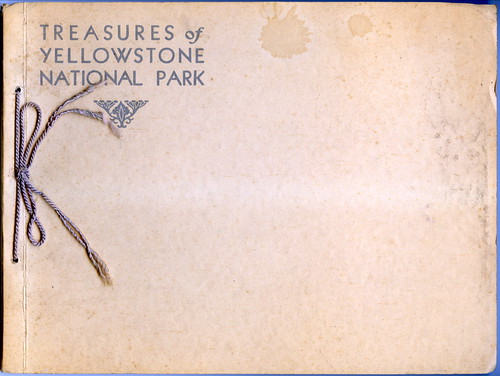
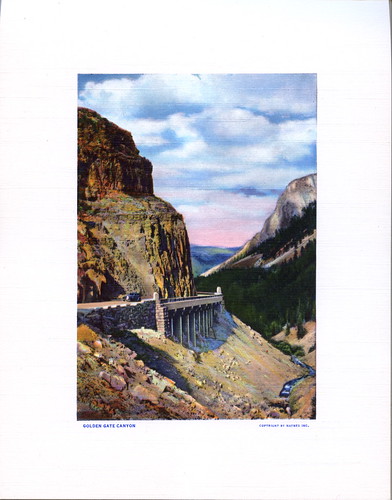
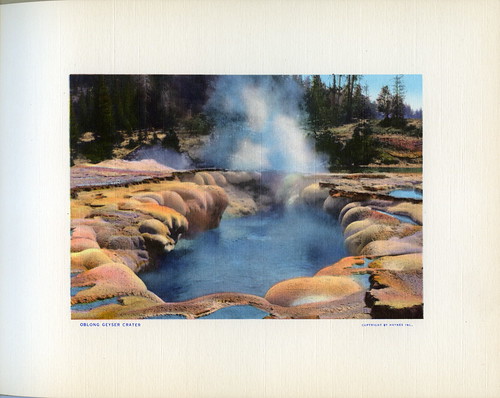
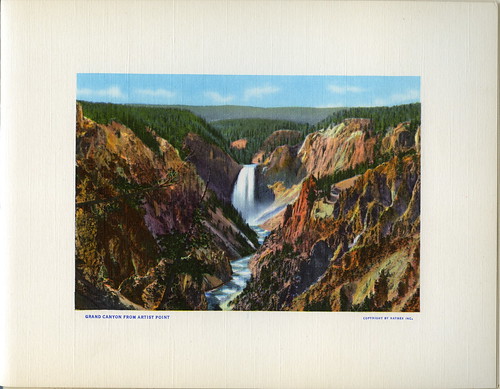
Treasures of Yellowstone National Park


These are some of the images from a souvenir book by Haynes Inc. Yellowstone Park, Wyoming (according to the back cover) that my Great Grandfather Andrew picked up on his trip west to see his brother Alfred in San Fransisco sometime in the '20s. I'd had the book for a while, but hadn't looked at it, expecting the typical black and white illustrations of the time. Instead, it had eighteen gorgeous lithographs, on a linen textured paper. Except for a small stain on the cover, the book is in excellent shape, and looks as though it has hardly been handled.

Labels: , , ,

Sunday, June 11, 2006

Another Scanning Project

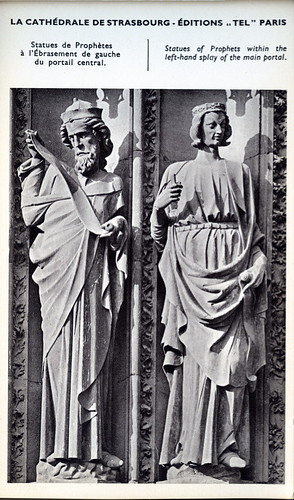
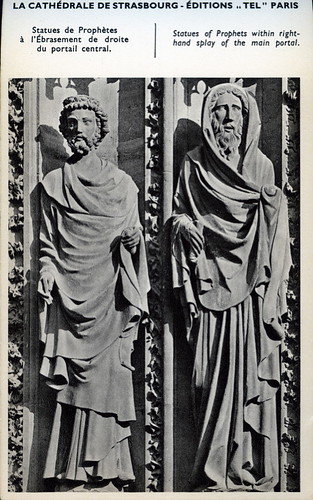
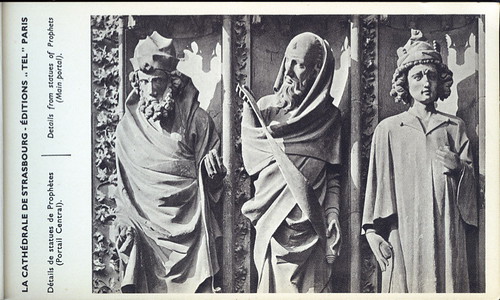
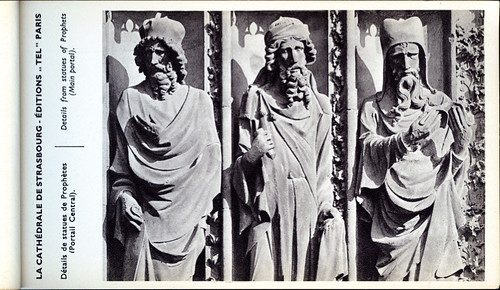
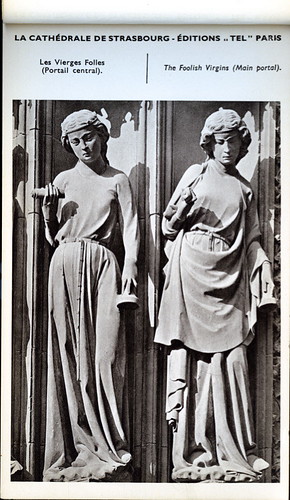
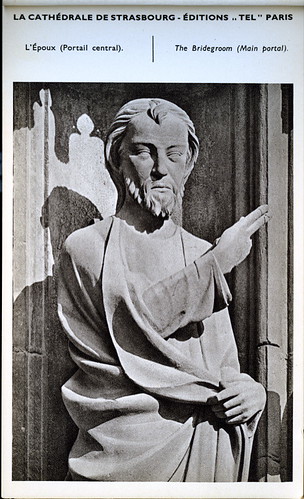
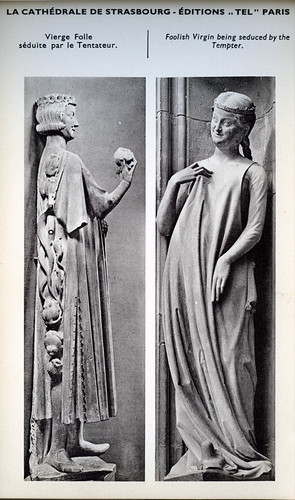
Another vintage photo resource I have recently aquired is a small (4X7 inches) photo-book La Cathedrale de Strasbourg, Editions "Tel". It looks to have been printed somewhere between the 'teens and the 'thirties. The book contains shots of some of the portal figures of prophets and virtues that I have never seen photos of anywhere before.


There are also some excellent shots of the Wise and Foolish Virgins, which I have seen some photos of elsewhere.


One image related to the Virgins which I had never seen (which is odd, considering it's central part in the parable) is the Bridegroom.


And though I had seen shots of these statues,


I don't think I had ever seen the left hand (male) figure described as 'the Tempter.'

Labels: , , , , ,

Friday, June 09, 2006

I have been having a lot of fun with Flickr, our new camera (a Kodak EasyShare C533) and my new scanner (an Epson Perfection 4990 Pro).

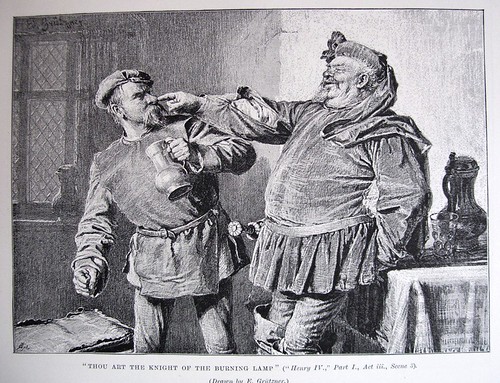
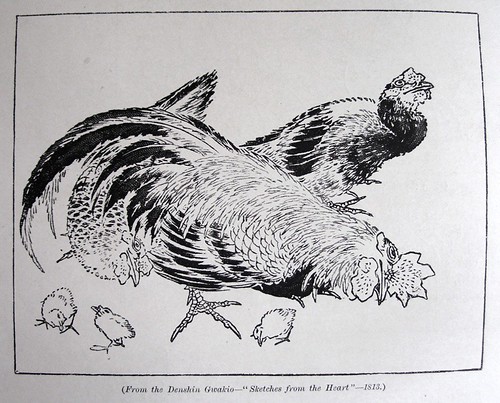
The latest project has been to photograph and download illustrations from some old books I got my hands on recently.

The following are from "Gems of Art" which apears to be an annual of 'the Magazine of Art.' Judging from the dates of attribute for the engravings, and a bio of a recently deceased (at that time) artist, I would place the date of publication somewhere in mid 1891.

Here are some samples from the over 375 illustrations.


Labels: , , , ,

Monday, June 05, 2006

Those who do not learn history are forced to repeat it.

"In these troubled times, when political and economic misunderstandings are erecting barriers between nations, as effectively preventing the interpenetration of ideas as if war had closed the frontiers, it is more than ever important that nations should think of each other in terms of some enduring aspect of the spirit which remains constant and free from the transitory confusion of current problems."

Thus begins the foreword of the exhibit catalog for "German Art From the Fifteenth to the Twentieth Century, an Exhibition of Paintings, Water Colors and Drawings Held Under the auspices of the Oberlaender Trust (and) the Carl Schurz Memorial Foundation, 1936-1937." which I recently aquired. Though I haven't found definitive information, I strongly suspect that at least one of the works in that show had been aquired by one of the participating German museums through a forced "Jew auction" (where the Nazis forced Jewish citizens to sell off their art and antiques at bargain prices).

I would love to find out that this exhibit was 'lilly white and pure' but given the history of that time, I have my doubts.

Even with the growing evidence of Nazi excesses, ill treatment of the Jews, agression and violation of treaties, inflammitory rhetoric from Hitler, the exodus of Jewish people and intellectuals, and the Nazi envolvement in '36 and '37 in the Spanish Civil War, there was still a great portion of the West that wanted only to "think of each other in terms of some enduring aspect of the spirit."

The result of that wilful blindness was over fifty million dead across Europe and the Pacific.

Will my grandchildren look back at some of the things written now about the need to 'understand and cross cultural barriers' and wonder how we could ignore the religious facism of Radical Islam?

Yes, Germany in 1936 had a long and glorious art history which had contributed greatly to the culture of the world. That art did not save the millions who died as a result of Hitler's madness.

Yes, Islam and muslims have done many beautiful and meaningful things in the arts, in mathematics, and many other areas. Dwelling on such things will not defend us from a Nuclear Iran or from 'home grown' Wahhabist terrorists.

I hope that there will be grandchildren to look back and wonder at how foolish we were.

Labels: , , , , , ,

Monday, April 17, 2006

We've been on a family trip to Kentucky to see Grandma Yost for her 95th birthday (note, I originally put that at 96th, my bad -- ed.).

May you have many more, Mildred Yost.


To wind down after two days on the road (with three kids in the car) I watched “Harry Potter and the Goblet of Fire.” I didn’t see it in the theatres though I had wanted to, but with family and schedule I had to choose between seeing it by myself, or seeing “The Lion, the Witch and the Wardrobe” with my oldest son, Nigel. Nigel won. I think I made out as well, as the Narnia stories are wonderful and the film was very true to the original story. So tonight I watched the DVD of Harry Potter, and my first response was that it was time to re-read the books.

Again.

For the fifth time.


And that got me thinking.

We have become so used to the overflow of riches that we have in the West. I don’t mean money or goods, though we have those.
We have an amazing amount of knowledge and literature at our very fingertips. Sometimes we make fun of the ‘fans’ who devour popular books and endlessly debate minor points or pick out flaws that the author missed. ‘Trekkies’ are laughed at. HP is ‘just for kids.’ Pick a popular subject, and you can easily find those who will ridicule its followers. I can even remember reading a Dilbert strip where Dogbert chastises Dilbert for rereading a novel; after all, he knew how it was going to end.

Abraham Lincoln grew up owning, reading and rereading maybe a dozen books. Longfellow’s library was in movable cases, and there were so few that all of them were grabbed up and safely removed from a house he lived in when that house caught fire. The known library of Leonardo may have been two dozen books, or less.

Historically, people have read and reread the same bits of non-fiction and literature over and over again. People committed whole books to memory not because they were so much smarter than you and I, but because they read the ink off of the pages.

The bards of old memorized the Iliad and the Odyssey not just because they were the best literature, but maybe because they were the only literature available.

I don’t think we should laugh at the people who wear funny costumes, go to ‘Sci-Fi’ conventions and flash a Vulcan peace sign or sport a lightning bolt on their foreheads. They are a lot closer to the spirit of the ancient poets than we are.

Labels: , , , ,

Tuesday, February 14, 2006

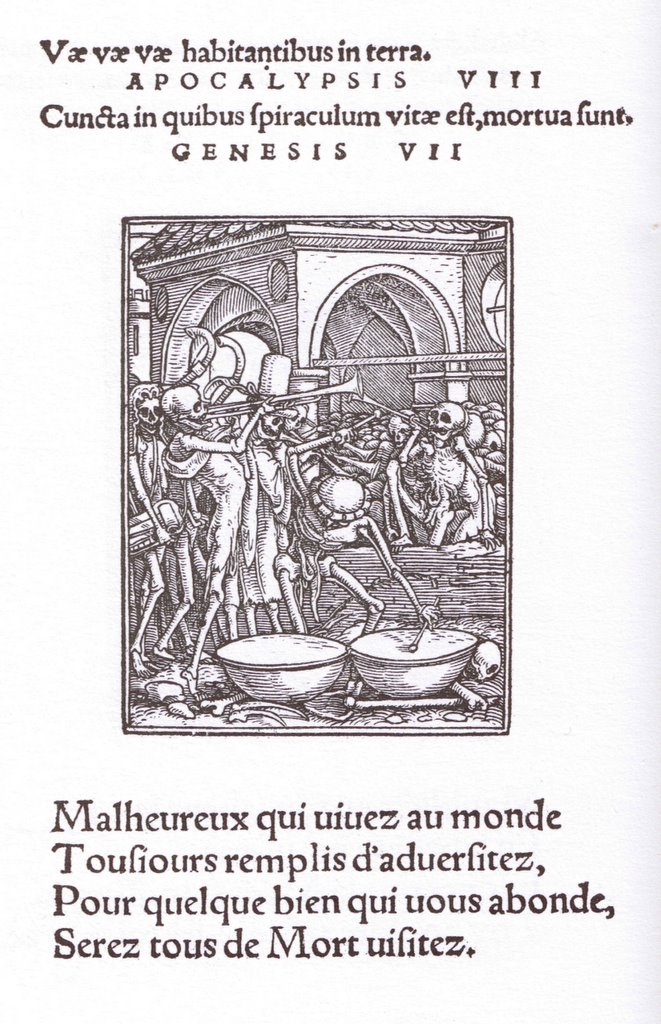
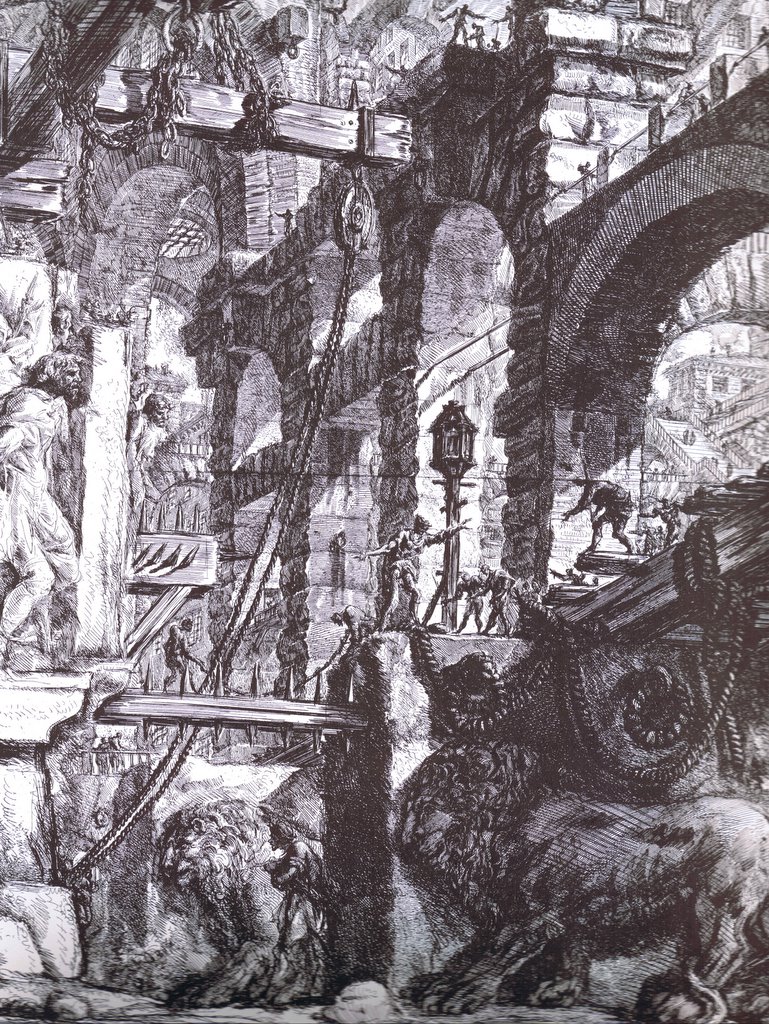
More Book Madness; Reviewing Dover Publications softcover editions of Giovanni Battista Piranesi's The Prisons (Le Carceri) and Hans Holbein the Younger's The Dance of Death.


Dover Publications has been in business since 1941, providing and reb]producing historic books on all subjects at reasonable prices. I purchased my first Dover Books in high school, some of Bridgman's Anatomy books, back in the late 70's, but I seem to remember some in the family library before then as well. For well used paperbacks these have held excellently, and I have even leant them out to drawing students from time-to-time.

Last year I ordered several books on art from Dover, inclucing The Dance of Death and The Prisons. Both of these books are lovely, and the images are reproduced with great care.


The Prisons (Le Carceri) may be the most complete reproduction of this series of etchings bu Piranesi that is available. Both series one and series two etchings are included, and all are printed at 60% of origional size (which makes them about 9 X 13 inches). The images are stunning, bringing to mind fantastical opera sets or the type of grandiose locations that Spielberg or Peter Jackson might create if they remade "Nosferatu." The sixteen plates, in both 'First State' and 'Second State' versions show imaginary dungeons, prisons and vast laberinths of stairs balconies and galleries that would be fitting for Dante's Inferno.

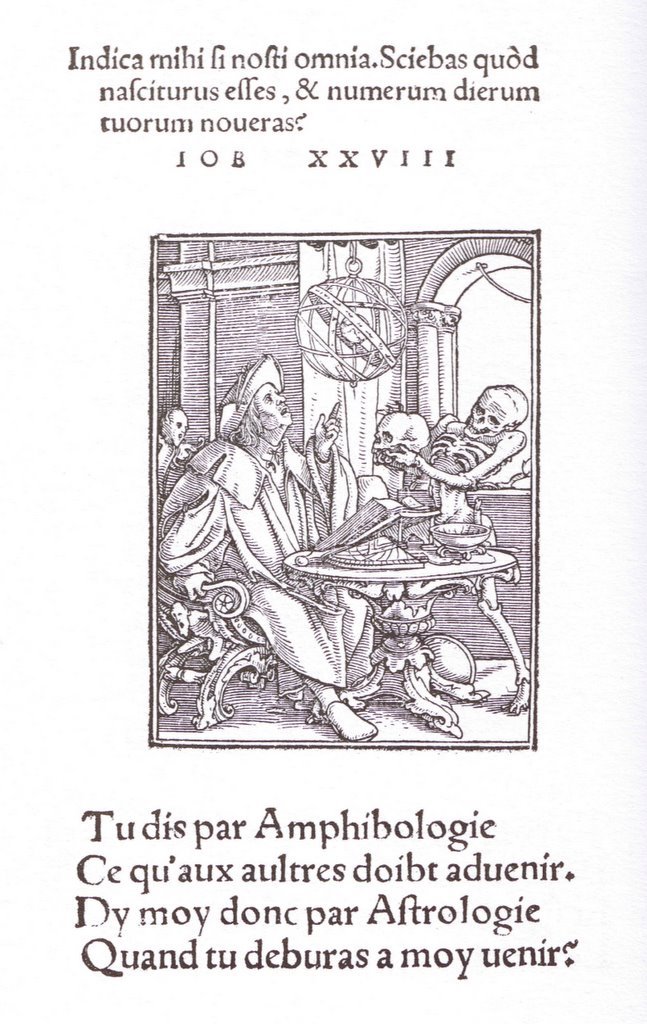
The Dance of Death is a complete view of Hans Holbein the Younger's 41 Woodcuts, in a complete facsimile of the original 1538 French edition. The plates are printed with the orgional Latin captions, and then again with modern English. Unfortunately the plates are rather small, being only 2 x 2 1/2 inches. I do not believe the originals were so small, but I may be mistaken. Also the origional essays that accompanied the original prints are not translated. This is unfortunate, but as an artist I find the book well worth having in spite of this. The woodcuts are simply wonderful.


I highly recommend Dover Books to anyone looking for reprintings of older references, and especially for specialty art references. For anyone interested in the Art History or 'fantastic' art, I would strongly recommend The Prisons and The Dance of Death.


Giovanni Battista Piranesi, The Prisons (Le Carceri) ISBN 0-486-21540-7 $18.95 US

The Dance of Death, 41 Woodcuts by Hans Holbein the Younger ISBN 0-486-22894-5 $8.95 US

Labels: , , , ,

Saturday, February 11, 2006

More Book Madness

Reviewing “Goya” by Sarah Symmons, Phaidon Art & Ideas series; copyright Phaidon Press Limited, Regent’s Wharf, All Saints Street, London England

Let me begin by saying that I am very pleased and impressed with the Art & Ideas series. All of them that I have browsed have been wonderfully put together for their very affordable prices. “Goya” is the second book from this series that I have purchased (following on the heels of ”The Northern Renaissance”. The reproductions are clear and of great quality and high detail, and the writing is by people with a deep knowledge and love for the subjects. “Goya” is no exception. Ms. Symmons’ writing is thorough, in depth, and accessible. Not only does she cover Francisco Goya’s life in great detail, but she also ties in a history of the prevailing social and political conditions, provides insight into Goya’s character and possible motivations, and highlights the legacy of his work and its continuing impact on artists.

I would highly recommend any of the Art & Ideas series to anyone who, like myself love art and art books, but want to purchase wisely and on a budget. I would especially encourage you to take a look at “Goya,” who is one of my favorite artists.

Labels: , , , ,

Monday, January 30, 2006

More Book Madness, a Review of “A Masterpiece Reconstructed, The Hours of Louis XII

This is an absolutely gorgeous book, especially for anyone interested in medieval art or history. It is edited by Thomas Kren (Curator of Manuscripts, The J. Paul Getty Museum) and Mark Evens (Senior Curator of Paintings, The Victoria and Albert Museum), with essays by Janet Backhouse (Curator of Illuminated Manuscripts, the British Library, since deceased), Thomas Kren, Nancy Turner (Associate Conservator of Manuscripts, The J. Paul Getty Museum) and Mark Evans.

The subject is the remaining parts of a book of hours, commissioned by Louis XII of France from Jean Bourdichon in the mid-to-late Fifteenth Century. The writing is exceptionally clear and readable, showing the great love of the subject held by the authors whose illustrious titles might make one fear that this would be a less accessible and more technical book. The plates and illustrations are beautiful and clearly printed, with numerous details and enlargements. The essays place the Hours of Louis XII clearly within the context of Bourdichon’s work, as well showing the connections with Flemish illumination styles, and the work of Jean Fouquet (who preceded Bourdichon as illuminator to the court in France). They also show how the Hours fits into the evolving trends of figure painting and subject matter in medieval times, and even how the subject choices reflected Louis’ character. I especially enjoyed Ms. Turner’s essay explaining Bourdichon’s manuscript painting techniques and materials. The final essay covering the provenance of the manuscript after it became broken up (somewhere before 1700) is also excellent, clearly showing the academic detective work necessary in understanding and reuniting the Hours.

I highly recommend “A Masterpiece Reconstructed” for anyone interested in art history or the Middle Ages, or anyone simply interested in beauty.

Labels: , , , ,

Saturday, January 21, 2006

More Book Madness


My lovely wife ordered Spectrum 12 for me, and it just came today.

(She got me the Science Fiction Book Club edition; the link above is the regular hardcover version from Amazon)

The Spectrum series is an annual compendium of "the Best in Contemporary Fantastic Art" edited by Cathy & Arnie Fenner. The images are gorgeous, well and carefully reproduced, covering fantasy, science fiction, editorial and illustration art, as well as unpublished works and three-dimensional art. This edition's jury included the artists Jon Foster, Anita Kunz, Karen Palinko (sculptor) and William Stout (a favorite of mine) as well as Irene Gallo, the art director of Tor Books and David Stevenson, the art director at Del Rey Books.

The pages are graced by the work of Brom, John Jude Palencar, Michael Whelan, Michael William Kaluta, and many many others.

Especially interesting are a number of paintings by Dave DeVries, (like “Old Scratch and The Fish”, which won the Silver award for Institutional art) where he beautifully and very faithfully creates paintings with depth and chiaroscuro based on the drawings of various seven year olds (which are included for comparison).

Movie fans will be happy with the many pieces of concept art from "Robots: The Movie" and "The Lion, the Witch and the Wardrobe."

I have to say that I'm not a big fan of this year's Grand Master Award winner, H.R. Giger, although I can understand his place in SF and fantasy history. His images are far too dark, dwelling upon evil and corruption for my tastes. I also need to warn some of my readers who may be offended by some of the other disturbing images dealing with monsters/evil and sexuality. They really aren't many, but they are a part of the illustration market where some of the bigger consumer/publishers are companies like Playboy enterprises. If you are squeamish about such then you may want to avoid Spectrum.

I am pleasantly surprised at the even hand given to political images, especially considering the level of vindictiveness in current politics. A couple of the images fit that vindictive level, but they are pretty evenly split between the left and the right of the political spectrum. Kudos to the Fenners, there really is a part of the press that is impartial!

Spectrum 12 will get a lot of handling from me, like all of the previous volumes in the series. Anyone with an interest in art that strays away from the strictly real world will enjoy it as well.

Labels: , ,

Friday, January 20, 2006

Today, the family went to the Museum of Fine Arts in Boston.

We have a family membership, and my wife takes the kids in each week for an arts and crafts class. I should know better than to tag along, as inevitably the first thing I do is browse through their excellent bookstore.

An expensive mistake...

Now on the shelf,

A Masterpiece Reconstructed, the Hours of Louis XII Thomas Kren & Mark Evans eds. ISBN 0-89236-829-2; The J. Paul Getty Museum and The British Library, in association with the Victoria and Albery Museum

Gothic Sculpture, 1140-1300 Paul Williamson, ISBN0-300-07452-2; Yale University Press, Pelican History of Art

the Gothic Enterprise, a Guide to Undestanding the Medieval Cathedral Robert A. Scott, ISBN 0-520-24680-2; University of California Press

I also picked up "Medieval Objects in the Museum of Fine Arts, Boston, Metalwork" from the discount bin, and the 2006 Artist's & Graphic Designer's Market (ISBN 1-58297-396-2; Writers Digest Books).


I had previously gotten Gothic Architecture by Paul Frankl, from Yale University Press, Pelican History of Art, and was very pleased with it. Clear, concise, plenty of quality illustrations (though mostly small and black and white) and excellent research for my painitngs.

As soon as I'm done with one, I'll attempt my first book review for the weblog. It will probably be 'the Hours of Louis XII' as I already started reading it in the car while waiting for the family to get out of their class. The reproductions are excellent and the scholarship (being a companion book to an exhibit) looks to be of matching quality or better.

Labels: , , , , ,